Egyptian Art
The Rosetta Stone
https://smarthistory.org/the-rosetta-stone/
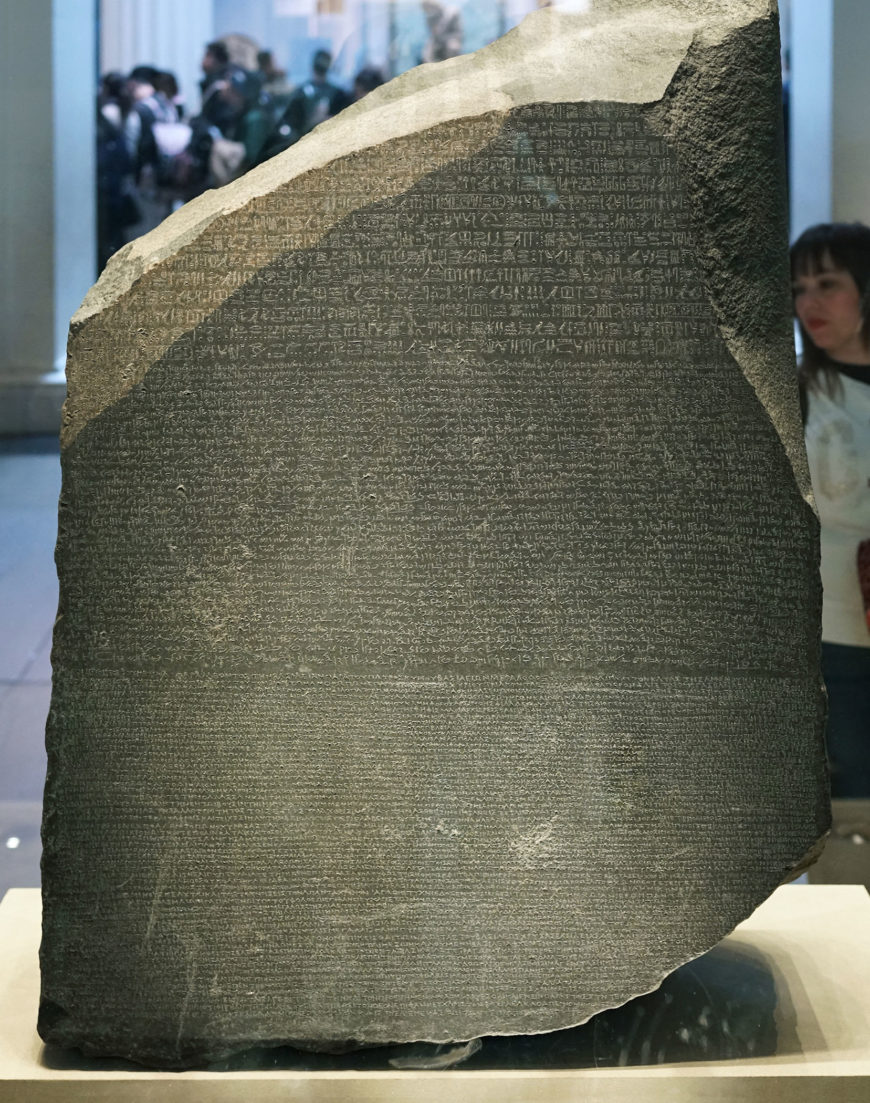
The Rosetta Stone is a large piece of granodiorite with writing covering the entire front surface of the stone. It was made in the Ptolemaic period of Egypt. This stone has great significance, both at the time it was created, and currently. It is covered in religious text, that at the time was used for ceremonies, but now currently, is used to translate hieroglyphics. The stone itself is rather large, and consisting entirely of rock is rather heavy. The words around the rock seems to have change languages due to the difference in shapes of the writing. If you look closely, you can pick out 3 different formats of writing, all in a different language. This is likely what lead to many of the translations being created. The piece of stone pictured is fractured and broken, as it was once part of a much larger piece. The fractures around the stone do not seem to be smooth, or orderly, and this cuts off much of the text.


It is amazing to see what people were able to do with so little. I saw that you said there are 3 different formats of writing possibly in different languages. I wonder if multiple people wrote this or it was just one person with all of the knowledge.
ReplyDeleteHi Stephen,
ReplyDeleteI really liked the piece you decided to describe as it's such an amazing artifact to have now, and it is crazy to believe that this was their language during that time and how much it has changed for the years of different cultures evolving throughout the centuries. It is also so crazy how big this piece is when it is just a small chunk of a larger piece makes me wonder how big the actual piece was, and if it was super tall, did they use a ladder every time they needed to read it?